Showing posts with label Ilesde-la-Madeleine. Show all posts

Saturday, January 10, 2009

Ghostly Tales From The Lonely Iles

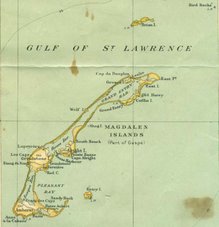
I have heard of the story of the black man found dead upon the shores of Pointe-aux-Loups often enough. You must understand that the man had wash up on shore, only to be found by a culture who had rarely, if ever heard of a black race. To say this body disturbed them would be an understatement.

As the story goes:
"There is a sand hill southwest of Pointe-aux-Loups Island which is called 'Negre'. Here, many years ago, a giant of a man was found dead upon the shore. The color of his skin was black and there were no papers upon his person to tell whom he was or from where he had come from.

How he came to be on the shore was a mystery, as no ship had been reported wrecked at any time upon any of the islands. From the condition of the body, the man had not been dead for any length of time.

The fisher folk of the islands buried the man in the sand dunes on which his body was found. But their native superstition made them shun that lonely part of the bleak shore over which the terrific Atlantic winds blow for weeks without let up.

A few weeks after the man was buried, some men, wandering along the lonely shore looking for driftwood blown up on the beach, to use as fire wood to heat their homes during the long, cold winter, saw the body of a man lying near the spot where the unknown person had been buried and where a wooden cross stuck up out of the sand.

The mystified islanders found that the uncovered body was that of the man they had previously buried. The body was lying near the mound of sand that had been his grave, but which appeared not to be disturbed.

The islanders once again buried the body, this time next to the first grave, since no one would uncover the first mound of sand. They placed another cross in the sand beside the first, and the left him there.

The story spread about the islands that the man had refused to stay buried, and soon there were tales that the dead man trod the shore at midnight, searching the thundering waters in vain for the ship from which he had been tossed into the turbulent seas.

Another few weeks went by, and curiosity took several Magdalen Islanders to the double grave of the unknown man. As they suspected, the dead man was lying uncovered beside the two other graves that had been dug for him. Both of those graves seemed to be intact.

The people were reluctant to have a dead man, or his ghost, haunting their island, so after considerable discussion they decided to bury the man again. This time in a third grave beside the other two previous ones, each of which they had supposed was to be his last resting place.

This time, they buried the man face downward in the belief that he could not dig his way out. This time, the mysterious man stayed buried.

Later, green grass began to appear on the third grave, and to the relief of the men of the Magdalen Islands, there were no more reports of a dead man parading the midnight shore." All was well or so the people thought....

But apparently the story of the dead black man doesn't end there. Some time later, he was once again found upon the sand hill with three undisturbed mounds where he had previously been buried. This scared the people seriously and they decided to send word to the traveling priest, who visited the islands once in a while. Remember, this happened at a time when the islands didn't have a regular live-in priest, because very few people lived here.

To make a long, involved story short..., the priest came right away and the people gave the man a proper Catholic burial in consecrated ground. They didn't have a name for him and the cross that identified the grave has long since rotted away. But the man didn't come unburied after that. The people assumed that somewhere along the man's journey through life, he had been baptized and required a christian burial.

Tuesday, December 9, 2008

The Islands Richelieu Club To Donate Christmas Food....

The Richelieu Club put the past weekend to good use by collecting the money to buy Christmas baskets of food. The amount of food they will buy surpassed all that was expected. Islanders generously contributed the equivalent of some hundred fish baskets full of food, explained the coordinator of the event, Jocelyn Thériault. This is 20% more that was donated last year.

Note: A fish basket is approximately thirty gallons, I would say..., maybe a little less.

The president of the Richelieu Club, Élie Chevrier, said that his part was the sale of tickets for a drawing, until the start of January, will allow for the addition of around ten baskets of a thousand dollars worth of perishable food baskets for Christmas. The distribution of the Christmas baskets, to the families with children in need, will commence around Saturday the 20th day of December.

I imagine that there are quite a few families that live under the poverty level, here on the Magdalen Islands. But not many, if any, go hungry or don't have at least the basic needs to survive well. Unlike on the mainland, if a recession or heaven forbid, a depression hit, the islands would suffer seriously, but food would still be plentiful because islanders have depended on the sea for their survival for centuries. The soil of the islands is rich and although not much of it is being used for farming, the potential for it's use is there.

Most people have regular jobs on the islands. Some full time, others work seasonally. There are a few who live on social assistance, drawn from the provincial government. Most of the seasonal workers do draw unemployment insurance from the Federal government, but many must repay the money when they start work in the spring. The islands economy has traditionally been based around fishing but for the past twenty years or so, the tourist industry has made leaps into a close second for the top spot for the economy. The salt mine probably runs third for employ ability. Then there are wide ranges of local business owners and their employees.

Sunday, October 5, 2008

An Interesting Bit of Islands Lighthouse History

In 1828, Captain Edward Boxer sent a report to the Grand Admiral of Maritime Britain, in which he mentioned: "I have found a great need for lighthouses in the Gulf of Saint Lawrence. On this sea, navigation is so dangerous because of strong and irregular currents, and there is not a single lighthouse in all the Gulf. It is truly lamentable to find so many shipwrecks at different places on the coast... the number of lost lives is very large and certainly incalculable...."

One of the most talked about shipwrecks on the Magdalen Islands is the immigration ship, the "Miracle", which was transporting families from Ireland to Canada, when she went ashore at East Point during a violent storm. The Captain of the "Miracle", Master H.H. Elliot, while expressing his gratitude and admiration for their Magdalen Islands rescuers in his report, highlighted the necessity for having lighthouses in these areas. "This is to certify that the ship "Miracle" under my command wrecked on the Magdalen Islands on the 19th, of May, 1847, with 446 souls on board, and through the exertions of Mr. James Clark and his sons succeeded in saving nearly the whole of them and they deserve great praise for their exertions, both in supplying them with provisions and shelter.
I firmly believe a light on the east end of the island would save many a shipwreck, as Brion and Bird Rocks can be sure."

Note: The ship "Miracle" carried a ship's fever, typhoid, when it went ashore. The victims were cared for at East Cape, shelter in the home, barns and outbuildings of the Clark family. Mary Goodwin, James Clark's wife, contracted the contagious disease and died that same spring.

Also note: In July 1969, Leonard Clark, the great, great grandson of James and Mary, spearheaded a project to place a cross at East Point, where it was believed the victims of the "Miracle" were buried. The cross was very large, maybe 20 feet or more in height. It took many men to lift it into place. The cross blew down the next winter. The brass plaque had been removed and finally found it way to the museum, Muse de la Mer in Amherst.